



Category: Crisis Communications | Digital Platform | Systems Development | Product Strategy
Scope: Website Architecture, Secure Data Handling, Communications Strategy, Platform Scaling, Product Development, Collateral Rollout
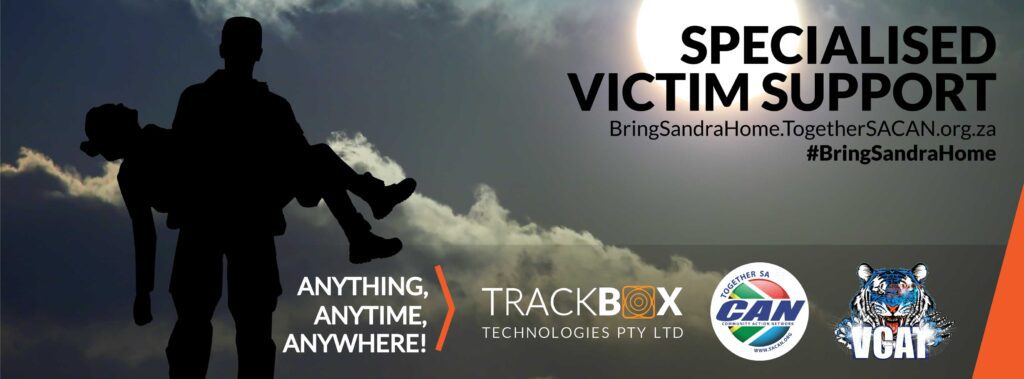
In 2019, following the kidnapping of Sandra Moonsamy in Pinetown, we were engaged to support Together SA CAN (NPO) with the development of a structured digital response platform.
What began as a single-case communication hub evolved into a scalable digital ecosystem supporting multiple investigations — and ultimately into a formalised subscription-based product offering: Specialised Victim Support (SVS).
This case study reflects the strategic, technical, and communication architecture that transformed crisis response into a structured, operational framework.

In 2019, following the kidnapping of Sandra Moonsamy in Pinetown, we were engaged to support Together SA CAN (NPO) with the development of a structured digital response platform.
The immediate objective was to create a secure and credible online environment that could:
Provide verified case updates
Enable anonymous public tip submissions
Centralise information flow
Support investigative sensitivity
What began as a single-case communication hub was intentionally architected to evolve — expanding into a multi-case digital ecosystem with structured backend coordination and controlled public engagement.
This progression ultimately led to the development of Specialised Victim Support (SVS) — a formalised subscription-based support model combining digital infrastructure, operational workflows, and defined response benefits.
This case study reflects the transformation of crisis response into a scalable, structured operational system.
(Delivered during tenure within the internal digital and brand strategy collaboration)
Provide a credible, centralised information source
Enable safe anonymous tip submissions
Share structured updates without compromising investigations
Support law enforcement processes
Manage public engagement responsibly
This required more than a website.
Information control
Backend logic for data handling
Structured timelines
Public engagement strategy
Discretion and security
The platform needed to serve both public visibility and investigative support — without disrupting active operations.
This engagement required rapid deployment with long-term architectural thinking — balancing public visibility with investigative sensitivity and backend control.
We designed and developed a dedicated digital platform that:
Published verified case updates
Structured incident timelines
Enabled anonymous public tip submission
Integrated backend tracking elements
Supported coordinated messaging across channels
Parallel to the platform, we implemented a managed social communications strategy to:
Amplify awareness
Track case milestones
Maintain credibility
Coordinate messaging with stakeholders
The objective was to create a responsible digital narrative — balancing transparency with operational sensitivity.
As the case progressed, a key insight emerged:
The system being built for one investigation could be structured to support many.
Instead of treating each case as a standalone initiative, we architected the platform to support:
• Multi-case dashboards
• Structured case pages
• Ongoing update streams
• Timeline tracking
• Pattern documentation
• Repeatable backend workflows
The website evolved into a modular ecosystem capable of supporting multiple investigations simultaneously.
This shift marked the transition from campaign-driven response to structured operational platform.
Through ongoing case management and platform development, structured learnings emerged around:
Case progression patterns
Stakeholder coordination flows
Public engagement triggers
Evidence-based intervention support
Response management sequencing
These insights were formalised into repeatable processes.
The platform was no longer just informational — it became an operational coordination tool bridging:
Victims
Law enforcement
Private security
Analysts
Public participants
The final evolution was the formal development of Specialised Victim Support (SVS) as a structured, subscription-based offering. What began as reactive crisis support became a structured service ecosystem with defined commercial value.
Defined benefit limits per incident
First response coordination
Medical and life support dispatch
Crime scene coordination
Protocol and forensic liaison
Case management support
Track & trace integration
Licence plate recognition integration
Facilitation services in event of death
Transforming a crisis-response platform into a formalised subscription product required:
Service architecture definition and benefit modelling
Tiered membership structuring (individual and family coverage)
Incident qualification logic and response sequencing
Operational workflow mapping across stakeholders
Product positioning and value articulation in a sensitive category
Legal and risk-aligned communication frameworks
Clear articulation of coverage limits and conditions
Visual and verbal system development for trust and credibility
This phase moved the initiative from reactive response into structured, commercially defined support capability.
We supported the full development and rollout of the SVS product ecosystem, including:
Full platform UX and structural design
Backend architecture coordination
Secure information submission flows
Communications strategy and messaging
Social media case tracking
Ongoing update management
Platform refinement to support structured membership access
User-facing landing pages and product explainer sections
Member documentation design and benefit summaries
Tier comparison frameworks
Collateral packs and information sheets
Campaign launch materials and social media rollout
Visual identity alignment across digital and print
Ongoing content updates and platform optimisation
Every touchpoint — from backend logic to outward-facing communication — was
aligned to ensure clarity, credibility, and operational cohesion.
This engagement demonstrates:
Crisis-to-system thinking
Digital platform architecture under pressure
Responsible communication strategy
Backend process design
Multi-stakeholder ecosystem alignment
Business model development from operational insight
The platform remains active and continues to support multiple cases under the SVS framework.
Crisis Communication Strategy | Digital Platform Architecture | Secure Backend Workflow Design | Structured Data & Timeline Systems | Multi-Case Platform Scaling | Social Media Narrative Management | Product Strategy & Commercial Structuring | Visual Identity & Collateral Systems | Ongoing Advisory & Ecosystem Support